Thursday, September 5, 2013

For September Brides and September Birthdays: "Something Blue"


For September Brides and September Birthdays: “Something Blue”

Hi, it’s Christa, your long-lost blogger!

Remember "Mind the Gap," my May 14 post about the gap between wedding bands and engagement rings? It’s a hot topic on the Web, and it mirrored what was happening in my own life then.   

Well, a few weeks ago, I married the love of my life. And, like many brides, I wore “something old, something new, something borrowed, and something blue.”

If you’re a September bride or have a September birthday, a piece of blue sapphire jewelry would make the perfect “something blue”.

Dress up a simple e-ring with a sapphire and diamond wedding band


The official birthstone for the month of September, blue sapphires symbolize hope, peace, happiness, faith, and fidelity. These are all marks of a lasting marriage and a fulfilling life.

Blue sapphires are also durable; only diamonds are harder.  You can love them for a lifetime and then pass them down to your children.

Blue sapphire is one of the four gemstones historically regarded as “precious”. It’s been worn by royalty for at least 1,500 years, since the days of ancient Greece.  You may not be the “princess” type, but who doesn’t want to feel regal while walking down the aisle?    

A plunging neckline is the perfect frame for a sapphire pendant


We have so many beautiful blue sapphire pieces in the shop, including pendants, rings, and earrings. Steward, our owner, can also custom-make the jewel of your dreams:

Stop by and see us today!

Thursday, August 1, 2013

The Timeless Art of Filigree

Some jewelry trends never go out of style. Filigree is one of them.


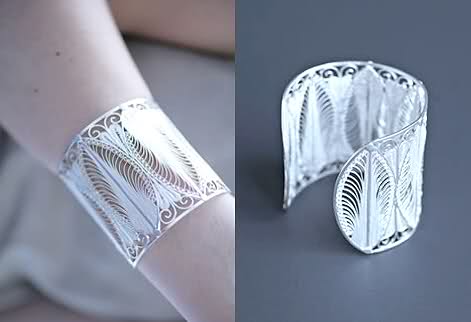
Filigree is a dance between metal and air.
For the past 5,000 years, artisans have been using this metalworking technique to craft breathtaking pieces of jewelry. The process is relatively simple; the results are anything but.    

Early Greek and Etruscan artisans would pound pieces of metal (usually gold or silver) into lengths of slender wire. Then, by curling, twisting, or braiding, they'd shape the wire into delicate, open, lacy patterns.
The pieces of filigree could then be soldered together to make larger pieces. Sometimes, a craftsman would solder filigree to a solid sheet of metal, adding strength to one and delicacy to the other. Using this method, he could adorn larger objects like boxes, tea sets, chalices, and menorahs. 
Real filigree is always made by hand.

Over the centuries, more and more cultures fell in love with filigree. Each developed its own distinctive style. Irish craftsmen wove intricate knots from lengths of silver wire. Norwegians hung gold dangles from the elaborate filigree pieces both men and women wore with their traditional costumes. 
    
Flowers and leaves are traditional motifs.
Exceptional filigree jewelry is still being made all around the world. Some is traditional; some is more contemporary. Look for pieces made in Spain, Portugal, India, Russia, and Greece. Whichever style you prefer, you'll be wearing a real piece of art.
A cuff bracelet with a contemporary feel.